Separate what you know from what you assume
ETS specifies that geometric figures are not necessarily drawn to scale; coordinate systems, number lines, and data charts are drawn to scale. However, lines shown as straight, the order of points on a line, and the relative positions of objects should be respected. In a geometric figure, a triangle that looks isosceles cannot be assumed to be isosceles without supporting information.
Make two columns in your notes: given and derived. “Right angle at B” belongs in the given column if the prompt says so. “AC² = AB² + BC²” is then a deduction. An impression that AC is about twice as long as AB belongs in neither column. This discipline also helps with comparisons where multiple figures satisfy the same information.
Figure 1: a height, a base, and an area
The text description contains all the information needed. Triangle ABC is right-angled at B; AB is 9 and BC is 12. Side AC is not given. All lengths use the same unit. Do not measure the drawing.
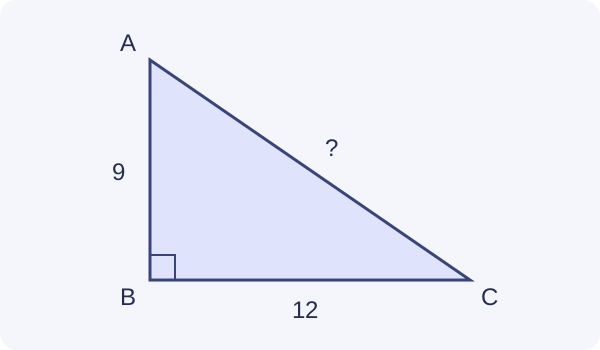
Triangle ABC is right-angled at B. AB = 9 and BC = 12. What are the area of the triangle and the length of AC?
Enter your answer before viewing the review.
The solution, step by step
Area: 54 square units; AC = 15 units.
The method in action
- The two sides forming the right angle are perpendicular: area = 9 × 12 / 2 = 54.
- By the Pythagorean theorem, AC² = 9² + 12² = 81 + 144 = 225, so AC = 15. AC is a positive length.
- 108 omits the division by 2 in the area calculation; 21 adds the two sides instead of using the Pythagorean theorem. The length 15 is greater than 12 and less than 21, which is consistent with the triangle.
Figure 2: reason with the base and height
ABCD is a rectangle with width 10 and height 6. M is the midpoint of AB. Triangle DMC is shaded; its base DC is 10 and the distance from M to DC is 6. The shading provides no additional information.
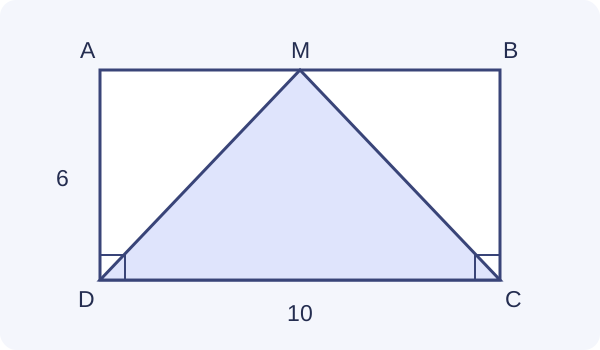
Rectangle ABCD has width 10 and height 6. M is the midpoint of AB. What fraction of the rectangle’s area is occupied by triangle DMC?
Enter your answer before viewing the review.
The solution, step by step
1/2.
The method in action
- The rectangle has an area of 10 × 6 = 60. The triangle has the same base, 10, and the same height, 6, so its area is 30.
- The fraction is 30/60 = 1/2. M being the midpoint helps show the symmetry, but it is not needed for the area calculation: any point on AB would have the same height above DC.
- 1/3 comes from visually counting the three triangles without comparing their areas. Each of the other two triangles has area 15, not 30.
Exercise 3: length and area scale differently
When two plane figures are similar, a length scale factor k > 0 produces an area scale factor of k². This follows from multiplying two dimensions to find area, not from a rule based on the drawing’s appearance.
Two similar triangles have corresponding side lengths in the ratio 2:5. The smaller triangle has area 24. What is the larger triangle’s area?
Enter your answer before viewing the review.
The solution, step by step
150.
The method in action
- The length scale factor from the smaller triangle to the larger one is 5/2. The area scale factor is (5/2)² = 25/4. The area is 24 × 25/4 = 150.
- 60 would scale the area by the length factor alone. Reversing the ratio would give the larger triangle a smaller area.
The pitfall
The pitfall to avoid
Measuring an angle or length on a schematic figure is a mistake. Even if the drawing looks precise, your conclusion must come from the prompt or an established property. If the information is insufficient, imagine two different figures that satisfy it.
Redraw after stating the given information
Cover a figure and reconstruct it from its description. If you add equal sides or a right angle that was not stated, you have identified a personal assumption. Then look at the drawing again and label each deduction with its reason: perpendicularity, angle sum, similarity, or area formula.
This workshop covers a few fundamentals, not all GRE geometry. Also review the English vocabulary associated with the figures you study. Recognizing midpoint, perpendicular, and corresponding prevents you from missing information before you begin reasoning.
Key takeaways
- The given information takes priority over appearance.
- The area of a triangle uses a base and its corresponding height.
- A length scale factor k produces an area scale factor of k².